


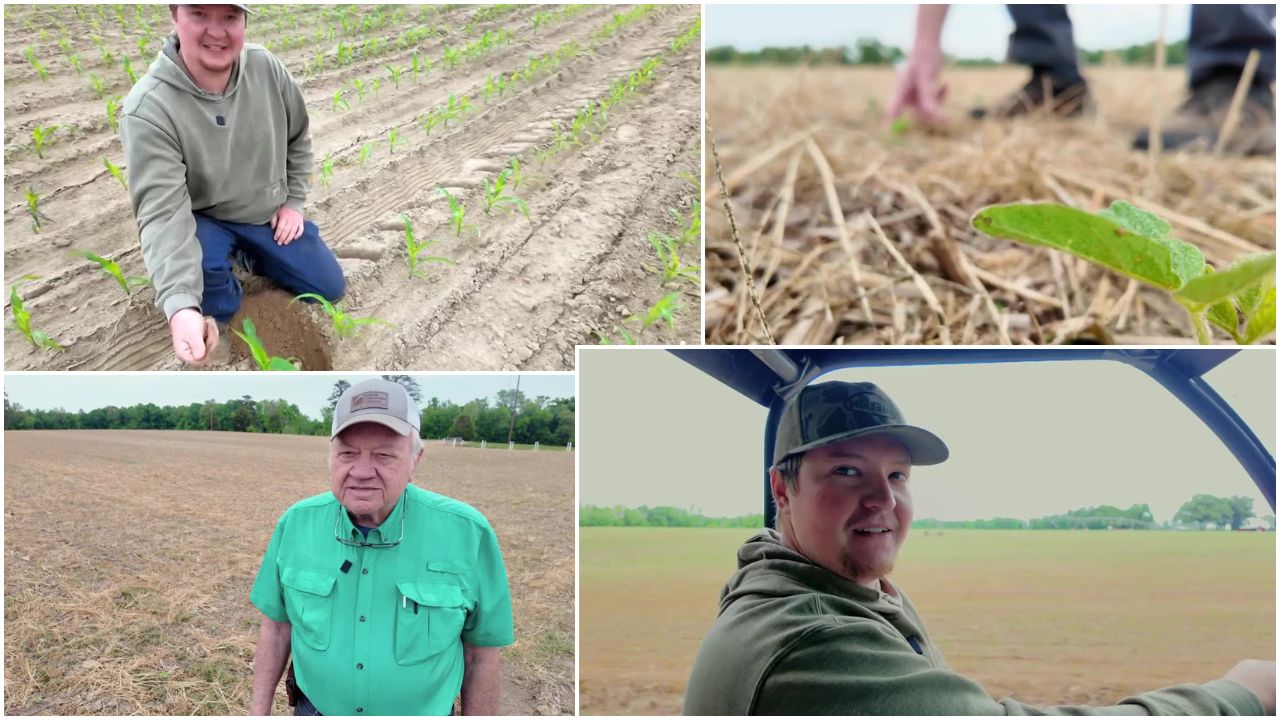


DINWIDDIE COUNTY, Va. — Virginia farmers are facing what some are calling the worst drought in decades, with dry conditions dating back to late 2025 threatening crops, driving up costs and pushing some operations to the financial edge.
At Double B Farms in Dinwiddie County, 81-year-old Billy Bain — a well-known Virginia farmer who has testified before Congress six times on behalf of agriculture — is in his 58th year of planting crops. He says this drought stands apart from anything he has seen before.
"In my opinion, it's the worst ever. We always use 1980 as a benchmark for a terrible drought," Bain said.
The dry conditions have halted planting operations entirely at points this spring.
"We had to stop planting because it's so dry," Bain said.
Bain's grandson, Aaron Hale, said the conditions are unlike anything he has experienced.
"I haven't witnessed it this dry in April, ever," Hale said.
WATCH: Extreme drought expands to more parts of Virginia
Soybeans planted earlier this month have barely emerged from the ground.
"I planted these beans April 1st," Hale said. "And the ones that came up, they have not gotten any bigger with no rain."
An entire soybean field will need to be replanted, according to Bain.
"It looks like maybe one or two percent have come up. You've got a plant here, and you skip 18 inches, and here you got 3," Bain said. "And in that period, we should have had 20 plants and we only have four."
The farm's 1,000 acres of corn are faring no better. Hale said the soil has nothing to offer young seeds.
"Looking to see if there's some moisture, there's a little bit in this ground, cause it's had some deep tillage this year.," Hale said. "ut it's not enough to make a seed come up. It's just powder dry. Nothing to it."
Some corn fields also sustained frost damage, compounding the drought's toll.
Hay crops planted to support the farm's cattle have come in at roughly a third of their expected yield.
"Well, the dry weather shortened it," Bain said. "We should have had our first cutting of hay in the barn, but it's out there. The growth is about a third of what it should be."
Crews spent much of Thursday morning working on equipment to plant peanuts, but that crop faces the same challenge as the others without meaningful rainfall.
Irrigation is an option, but not a cheap one. Pumping water from ponds requires electricity or diesel fuel, adding to an already strained budget.
"It's very costly per day, especially when you are looking at diesel fuel prices at $4 for off-road, over $5 on road, so just another cost when you have dry weather," Bain said.
The drought is hitting farmers at a particularly difficult time, with high input costs and low commodity prices already squeezing margins. Bain said the combination is taking a serious toll across the state.
"If you look at the State Drought Monitor, the whole state is pretty much in trouble," Bain said.
Both Bain and Hale said they will need to replant some crops for a second time. But without significant rainfall soon, they say they will not be financially able to replant for a third time.
CBS 6 is committed to sharing community voices on this important topic. Email your thoughts to the CBS 6 Newsroom.
📲: CONNECT WITH US
Blue Sky | Facebook | Instagram | X | Threads | TikTok | YouTube

This story was initially reported by a journalist and has been converted to this platform with the assistance of AI. Our editorial team verifies all reporting on all platforms for fairness and accuracy. To learn more about how we use AI in our newsroom, click here.

