




CHESTERFIELD COUNTY, Va. — Adrian Murray teaches his students that success means more than earning a good grade. It means finding purpose, persevering through challenges, and knowing when to lean on others.
Eight years ago, the Monacan High School educator needed a community of his own.
Murray collapsed during a school tug-of-war competition on Oct. 10, 2018. He went into cardiac arrest three times in the ambulance, where paramedics used CPR and defibrillation to revive him.
Their work gave him the chance to return to his classroom, become a father, and turn a frightening experience into a mission to help others.
But for years, he did not know the names of the people who helped save his life.
That changed during an interview with CBS 6 Anchor GeNienne Samuels, when Captain Bo Britton and Lt. Chip Loving of Chesterfield Fire and EMS walked into his classroom for a surprise reunion.
“I know the Hulk isn’t coming. I know the Green Lantern isn’t coming,” Murray said just before they arrived. “But I know EMS is, and they’re the real heroes.”
A celebration turned into an emergency
Murray remembers standing at the back of the rope, anchoring a group of freshmen during the competition in Monacan’s auxiliary gym.
His team won. He began celebrating.
Then everything went dark.
“Right around here, it’s kind of where I just collapsed,” Murray said, pointing to the spot on the gym floor.
When he regained consciousness, coworkers were around him. School staff helped him to the cafeteria, but resting did not bring relief. He struggled to catch his breath and felt his heart racing.
“I was nervous. I was scared, disoriented, just really panicked,” he said.
Teachers, administrators, the school nurse and a school resource officer rushed to help.
Britton said the responding crew assessed Murray and placed him on a cardiac monitor. Recognizing that something was seriously wrong, he called for additional resources. Loving joined the response.
Murray’s condition continued to deteriorate.
During the trip to Chippenham Hospital, he suffered multiple cardiac arrests.
His next clear memory was waking up in the hospital, intubated and confused.
“I have no idea what just happened to me,” Murray recalled thinking.
His wife, Krys Murray, remembers receiving a call telling her to come to the emergency room. When she arrived, a doctor pulled her aside.
“They were doing everything they could, but they didn’t think he was going to make it,” she said.
She leaned on the faith she and her husband share.
“It’s really about praying and trusting God and believing that all will turn out well,” Krys said.
Surviving — and learning to live with the fear
Murray said doctors diagnosed him with arrhythmogenic right ventricular cardiomyopathy, or ARVC, an inherited heart muscle disease.
He spent eight days in the hospital. While his physical recovery progressed, processing what had happened proved more difficult.
According to the American Heart Association, about nine out of 10 people who experience cardiac arrest outside a hospital do not survive.
Murray returned to the school where he had collapsed, walking the same halls and passing the same gym. At first, those familiar places brought anxiety.
He recalled being acutely aware of every heartbeat. An alarm from the wearable defibrillator he initially used frightened him, even though he said it turned out to be a false alarm.
He considered transferring to another school.
Instead, he stayed.
Returning allowed him to face his fears and answer students’ questions about what had happened. Those conversations became opportunities to discuss heart health and emergency preparedness.
Today, standing in the gym brings a different feeling.
“I feel blessed,” Murray said. “The fact that I got a second chance at life, and I’m able to explain it to you.”
He takes medication and has an implanted cardioverter defibrillator, or ICD. He said becoming a father helped motivate his decision to get the device.
His daughter was born in 2020. Thinking about being with her if another emergency happened changed how he considered his options.
He wanted another layer of protection.
‘Thank you’ did not feel like enough
During his interview with Samuels, Murray spoke about the gratitude he carried for the school staff, emergency responders and hospital workers who helped him survive.
“It doesn’t hit you until yours is the life that they save,” he said.
Asked what he would say to the paramedics, Murray struggled to find words big enough.
“You start off with thank you, but it just doesn’t feel like enough,” he said.
Moments later, Britton and Loving entered his classroom.
Murray embraced them.
“You look a lot better today than you did eight years ago,” Britton told him.
For the first responders, the reunion offered a rare opportunity to see what happened after a patient reached the hospital.
“We’re thankful to get to see survivors like this because it does not happen that often,” Britton said.
Loving said Murray’s emergency was one he had not forgotten.
“Everything was going wrong, but we did everything the best we could for our training, and just didn’t want to quit and wanted to keep on going,” Loving said. “And you did the same.”
Seeing Murray back at school made the outcome especially meaningful.
“I feel honored to get to meet you in circumstances like this,” Loving said.
Murray wanted them to understand how far their actions reached beyond that ambulance.
The students he has taught since then. The young people he has mentored. The daughter he had not yet met.
“I didn’t have my daughter eight years ago,” he told them.
His survival made those relationships and experiences possible.
“My wife thanks you. My daughter thanks you,” Murray said. “You guys help me keep doing what I love to do.”
Teaching success, one student at a time
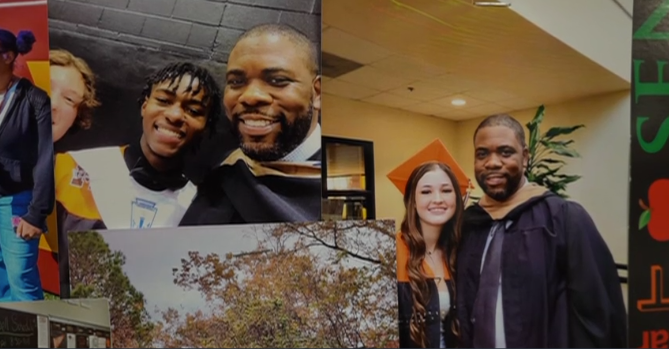
At Monacan, Murray is a success initiative educator. His class, called Success, focuses on character, leadership, and preparing students for life beyond high school.
Lessons include goal setting, study habits, healthy relationships and decisions about college, careers or military service.
For Murray, the work is personal.
He and a colleague helped shape the course into a place where students are celebrated and supported. They recognize birthdays and accomplishments, attend students’ games and create opportunities to build relationships.
He wants students to feel they can be themselves.
“I see them when they’re freshmen on the first day, and they have no idea what’s going on,” he said. “And then I see them graduate high school and get to play a small role in someone’s maturation.”
Murray was named Monacan’s Teacher of the Year. He appreciates the recognition, but says his students’ progress is the most meaningful measure of his work.
One former student, he said, is studying to become a history teacher and hopes to create a classroom like his.
“Just me being able to play a little role in their life to get them to where they want to be,” Murray said. “I mean, that’s the real reward.”
Making Monacan more prepared
Murray said his cardiac emergency also helped prompt a stronger focus on preparedness at Monacan.
The school became a Project ADAM Heart Safe School, and Murray said staff have greater awareness of the locations of automated external defibrillators, or AEDs.
He credits the school’s nurse and administrators with helping strengthen its readiness.
“If something does happen to someone, we are so much more prepared than when I had my event,” he said.
Murray also earned his Red Cross certification so he could teach others CPR and AED skills.
For him, sharing those skills is a way to extend the work of the people who saved him — helping someone act before emergency responders arrive.
T.R.I.N.I.T.Y.: Tennis, mentorship and a mission beyond the court
That commitment reaches beyond his classroom through T.R.I.N.I.T.Y., the nonprofit he leads with Krys.
The name stands for Teaching, Reaching, Inspiring, Nurturing and Igniting Today’s Youth.
The couple’s vision began in 2017, before Murray’s cardiac emergency. Rooted in their faith and shared passion for tennis, the program aims to support young people spiritually, mentally and physically.
Their approach combines tennis instruction with mentorship, encouragement and life lessons. They want participants to build confidence, character, emotional resilience and the skills to succeed beyond the court.
Through their Tennis for All initiative, the Murrays work to reduce financial barriers by offering free or low-cost programming and providing equipment to families in need.
For Adrian, the nonprofit is an extension of what he does at school: helping young people recognize their potential and giving them support as they pursue it.
Tennis also holds a special place in the couple’s relationship. Their first date was on a tennis court, he said, and playing together became treasured time for connection.
After his cardiac arrests, one of his biggest fears was losing that.
“The one thing that I was afraid of that I couldn’t do anymore was play tennis with my wife,” he said, “because that was kind of our time, our bonding time.”
He said he has been able to continue playing, even as he follows restrictions on other competitive activities.
Now, the sport is also helping the couple bring lifesaving education into the community.
Building healthy hearts and prepared communities
Through T.R.I.N.I.T.Y.’s Heart Strong Initiative, the Murrays combine opportunities to move and connect with education about cardiac emergencies.
“Along with the tennis sessions, we’re having demonstrations on how to do hands-only CPR,” Adrian said. “We’re doing demonstrations on how to put on the AED.”
The initiative includes heart health awareness, CPR and AED education, and youth and family wellness. Its tennis programming includes beginner-friendly Red Ball Tennis, which uses smaller courts and slower balls to make the game more accessible. playtennis.usta.com
Murray wants people to understand that emergency training matters even when they hope never to use it.
“You never know when you’re going to use those skills,” he said.
Each Oct. 10, he also celebrates what his family calls his “rebirthday” — another year of life after the day he nearly lost it.
The celebration has included cake, ice cream and, increasingly, community activities through the nonprofit.
A family celebrating a second chance
Days after the surprise reunion, Murray’s wife and their now-six-year-old daughter watched him help kick off the American Heart Association’s 2026 Central Virginia Heart Walk.
Samuels introduced him onstage as an honored survivor. He beat a drum and shared his story to encourage others to learn how to respond to a cardiac emergency.
Krys said the qualities that make him a dedicated teacher and mentor also helped carry him through recovery.
“I love his resilience. I love that he’s such a warrior. He’s such a giver,” she said. “I love how passionate he is about everything.”
Adrian credits her with helping him regain a sense of normal life after leaving the hospital.
“She helped me so much spiritually, emotionally, physically,” he said.
Now, he hopes his story offers others encouragement — and a reason to prepare.
The scar he carries is a reminder of what happened. But so are the students in his classroom, the family beside him and the people he can still reach.
“I’m here for a reason. I’m here because God’s not done with me yet,” Murray said. “I’m proud to be here. I’m proud to share our story. I’m proud that my pain has purpose.”
Learn more about the Murrays’ nonprofit, programs and opportunities to get involved at T.R.I.N.I.T.Y.’s website or T.R.I.N.I.T.Y. Tennis.
CBS 6 is committed to sharing community voices on this important topic. Email your thoughts to the CBS 6 Newsroom.
-
-
Eat It, Virginia! with Scott and RobeyUntold with Catie Beck
-
-
-
This story was initially reported by a journalist and has been converted to this platform with the assistance of AI. Our editorial team verifies all reporting on all platforms for fairness and accuracy. To learn more about how we use AI in our newsroom, click here.
 Facebook
 TikTok
 YouTube
 Blue Sky
 Instagram
 Threads
 X
